 Brigadoon Resurrected
Bringing Brigadoon Back
Brigadoon ran from 1993 to 2017, and then it was offline. The backups were years old and there was no clear path forward. One thing that survived was scattered across the people who played it: memories, a handful of saved logs, old character sheets, and fragments of documentation people had kept on their own computers for twenty-plus years.
What we’re doing here is writing a specification for how the game worked, collecting old areas, building from the ROM 2.4b codebase, and using AI to rebuild it.
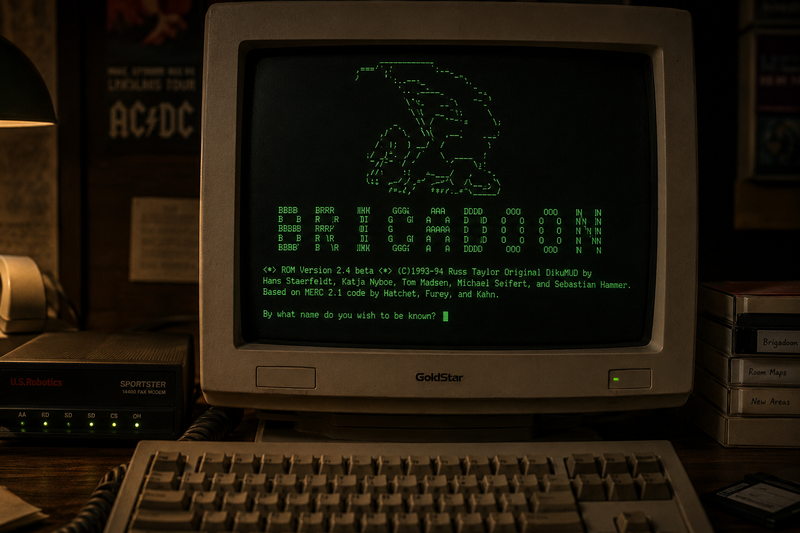 Some things you never forget the look of.
The approach
Brigadoon was built on ROM 2.4b, a well-known and still-available MUD codebase. That’s the anchor. Anywhere community memory is fuzzy or silent, the real stock ROM 2.4b source is the fallback — not guesswork. Anywhere someone’s memory is confident and specific, that takes priority over anything we’d otherwise assume or invent.
In practice that’s meant things like:
- Parsing every real stock ROM area file to build an actual data-driven baseline for mob difficulty, player stats, and the level curve, rather than eyeballing it.
- Tracking down public-domain area files that plausibly match Brigadoon’s own custom zones (a few builder credits and level ranges lined up closely enough to be worth pursuing), and checking their difficulty curves against that same baseline before deciding whether to use them.
- Rebuilding remembered races and classes — the playable dragon races, Fungus, the remort-only classes — piece by piece, cross-checking every number against whatever real data anyone could produce: dump files, old character sheets, other players’ independent recollections.
Where things stand
The rebuild is far enough along to actually play: character creation, remorting, a functioning class and race roster, item durability, and a set of world connections stitched back together room by room from whatever routes people could still recall. It’s live right now as a public alpha — see the who’s online page — with real players finding real bugs in real time, which is exactly how a project like this is supposed to work.
There’s still a lot of gaps. Some abilities are just names with no mechanical description left anywhere. Some areas have level ranges that don’t quite match what anyone remembers. Some of the roster (a good dozen more races, several more classes) hasn’t been touched yet, on purpose, because the data needed to build them responsibly isn’t there yet.
That’s the current phase: play the alpha, surface what’s wrong or missing, bring back whatever memory or documentation still exists, and keep closing the gaps — the same way everything built so far got built.